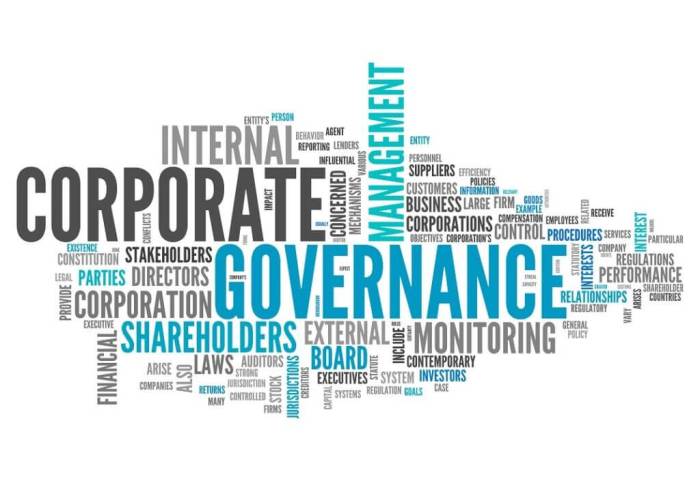
Financial auditing plays a crucial role in maintaining the integrity and stability of corporations. It acts as a cornerstone of effective corporate governance, providing assurance to stakeholders that financial reporting is accurate and transparent. Without robust auditing practices, companies face increased risks of fraud, mismanagement, and ultimately, financial ruin. This exploration delves into the multifaceted importance of financial auditing within the framework of corporate governance.
This examination will cover the core principles of financial auditing and corporate governance, demonstrating their interconnectedness. We will explore how audits deter fraud, enhance transparency and accountability, bolster investor confidence, and inform financial planning. Furthermore, we will address emerging challenges and future trends within the field, highlighting the continuous evolution of auditing practices in response to a dynamic global landscape.
The Role of Financial Audits in Preventing Fraud and Mismanagement
Financial audits play a crucial role in maintaining the integrity of a corporation’s financial reporting and preventing fraudulent activities and mismanagement. Independent audits act as a critical check and balance, providing assurance to stakeholders that financial statements accurately reflect the company’s financial position. The process not only detects existing irregularities but also serves as a significant deterrent against future misconduct.Independent audits deter fraudulent activities by introducing an element of accountability and scrutiny.
The knowledge that an independent third party will thoroughly examine financial records discourages individuals from engaging in fraudulent behavior. The audit process involves a systematic examination of financial records, internal controls, and business processes, increasing the likelihood of detecting any discrepancies or manipulations. The threat of detection and potential legal repercussions significantly reduces the incentive for fraudulent actions.
Corporate Scandals Resulting from Ineffective Auditing
Several high-profile corporate scandals highlight the devastating consequences of inadequate auditing. The Enron scandal, for instance, exposed the failure of auditing firms to identify and report fraudulent accounting practices, leading to the company’s collapse and significant financial losses for investors. Similarly, the WorldCom scandal involved massive accounting fraud that went undetected for years due to weaknesses in internal controls and ineffective audits.
These cases underscore the critical need for rigorous and independent audits to safeguard against fraudulent activities and protect stakeholders’ interests. The lack of effective oversight and the failure of internal controls in these instances resulted in billions of dollars in losses and eroded public trust in corporate governance.
Internal Controls and Their Verification Through Audits
Robust internal controls are fundamental to preventing financial mismanagement. These controls encompass a range of policies, procedures, and processes designed to ensure the accuracy, reliability, and integrity of financial information. Examples include segregation of duties, authorization procedures, regular reconciliations, and physical safeguards for assets. Audits play a vital role in verifying the effectiveness of these internal controls. Auditors assess the design and operation of internal controls, testing their effectiveness in preventing and detecting errors or irregularities.
A well-designed audit will include procedures to evaluate the effectiveness of key controls and identify any weaknesses that need to be addressed. The audit report then communicates the findings to management and the audit committee, providing recommendations for improvement.
A Flowchart Illustrating the Audit Process for Detecting Fraudulent Transactions
The process of detecting fraudulent transactions through auditing is multifaceted and iterative. A simplified flowchart could be represented as follows:[Imagine a flowchart here. The flowchart would begin with “Initiation of Audit,” branching to “Planning and Risk Assessment,” which then branches to “Testing of Controls” and “Substantive Procedures.” “Testing of Controls” would lead to “Control Weakness Identified?” A “Yes” answer would lead to “Further Investigation,” while a “No” answer would lead back to “Substantive Procedures.” “Substantive Procedures” would lead to “Evidence of Fraudulent Transactions?” A “Yes” answer would lead to “Investigation and Reporting,” while a “No” answer would lead to “Completion of Audit.” “Investigation and Reporting” would then lead to “Communication of Findings to Management and Audit Committee.”]The flowchart illustrates the iterative nature of the audit process.
The auditor continually assesses risks, tests controls, and performs substantive procedures to gather evidence. The process is not linear; findings at one stage may lead to further investigation in other areas. The ultimate goal is to provide reasonable assurance that the financial statements are free from material misstatement, including those caused by fraud.
Enhancing Transparency and Accountability Through Auditing
Regular financial audits are crucial for fostering transparency and accountability within organizations. They provide an independent assessment of a company’s financial health, ensuring that reported information accurately reflects the underlying reality. This process not only benefits investors and creditors but also strengthens public trust and contributes to a more stable and efficient market.Independent audits significantly enhance transparency in corporate reporting by providing a credible, external verification of a company’s financial statements.
The audit process involves a thorough examination of financial records, internal controls, and accounting practices. This rigorous scrutiny helps to identify and correct any inconsistencies, misstatements, or fraudulent activities. The resulting audit report offers stakeholders a level of assurance that the information presented is reliable and fairly represents the company’s financial position and performance. This, in turn, promotes greater confidence in the market and facilitates informed decision-making by investors and other stakeholders.
The Role of Audit Reports in Holding Management Accountable
Audit reports serve as a vital tool for holding management accountable for their financial stewardship. The report’s findings, including any identified weaknesses in internal controls or instances of non-compliance, are made available to the board of directors and other relevant governing bodies. This allows them to assess management’s performance and take appropriate corrective actions. Furthermore, publicly traded companies are required to release audited financial statements, making this information accessible to investors and the public.
Any discrepancies or irregularities revealed through the audit process can lead to consequences for management, ranging from reputational damage to legal repercussions. This accountability mechanism encourages responsible financial management and discourages unethical practices.
Key Stakeholders Benefiting from Transparent Financial Reporting
Transparent financial reporting, facilitated by auditing, benefits a wide range of stakeholders. Investors rely on accurate and reliable financial information to make informed investment decisions. Creditors use audited statements to assess a company’s creditworthiness and determine the terms of lending. Employees depend on accurate financial reporting for information about job security and the company’s overall health. Governments and regulatory bodies utilize audited financial information for tax purposes and to ensure compliance with relevant laws and regulations.
Finally, the public, including customers and communities, benefits from transparent reporting as it contributes to a more stable and trustworthy business environment.
Best Practices for Ensuring Transparency in Corporate Financial Disclosures
Implementing best practices is essential for ensuring transparency in corporate financial disclosures. A strong internal control system is paramount, encompassing clear segregation of duties, robust authorization processes, and regular reconciliation of accounts. A commitment to ethical corporate governance, including a culture of transparency and accountability, is vital. Regular and independent financial audits conducted by qualified professionals should be a cornerstone of the process.
Proactive disclosure of material information, both positive and negative, enhances transparency and builds trust. Finally, adherence to relevant accounting standards and regulations, including timely filing of required reports, is crucial for maintaining transparency and compliance.
Financial Auditing and its Interrelation with Financial Planning, Goals, and Advice
Financial auditing plays a crucial, often overlooked, role in informing and shaping a company’s financial planning, goals, and overall strategic direction. By providing an independent and objective assessment of a company’s financial health, audits offer invaluable insights that can significantly impact the effectiveness of financial planning and the achievement of long-term objectives. The relationship is symbiotic: effective planning leads to more accurate and reliable financial statements, which in turn strengthens the audit process and allows for more informed future planning.Audits provide a detailed snapshot of a company’s financial position, revealing areas of strength and weakness.
This information serves as a cornerstone for informed financial planning. For example, an audit might uncover inefficiencies in inventory management, leading to revised sales forecasts and adjustments to production schedules. Similarly, the identification of hidden liabilities or unexpected assets can significantly alter a company’s capital budgeting plans and investment strategies.
Audit Findings and Adjustments to Financial Goals
Audit findings directly influence the revision and refinement of financial goals. For instance, if an audit reveals a higher-than-anticipated level of bad debt, the company might need to adjust its revenue projections downward and revise its profit margin targets accordingly. Conversely, the discovery of previously unrecognized assets could lead to an upward revision of net worth and unlock opportunities for expansion or increased dividend payouts.
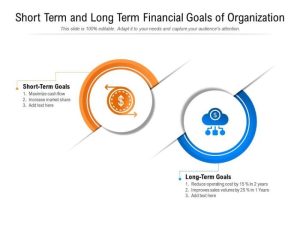
A thorough analysis of audit reports allows businesses to create more realistic and achievable goals. Consider a scenario where an audit identifies significant discrepancies in accounts receivable. This would prompt a review of credit policies, potentially leading to stricter credit checks and a revised collection strategy. The resulting impact on cash flow would necessitate adjustments to the company’s short-term and long-term financial goals.
The Role of Financial Advisors in Interpreting Audit Reports
Financial advisors act as crucial intermediaries, translating the often complex language of audit reports into actionable insights for their clients. They possess the expertise to analyze the audit findings, identify potential risks and opportunities, and recommend appropriate strategies to address any identified issues. Their role extends beyond simple interpretation; they help clients understand the implications of the audit for their overall financial health and future planning.
A financial advisor might, for example, explain the implications of a material weakness in internal controls identified in an audit report, advising on steps to strengthen these controls and mitigate future risks. They may also assist in developing strategies to improve financial performance based on the insights gained from the audit.
Integrating Financial Audit Results into Long-Term Financial Strategies
Best practices for integrating audit results into long-term financial strategies involve a systematic approach. First, the audit report should be thoroughly reviewed and discussed with the management team and financial advisors. Key findings should be identified and prioritized based on their potential impact on the company’s financial health. Then, a detailed action plan should be developed to address any identified weaknesses or risks.
This plan should include specific, measurable, achievable, relevant, and time-bound (SMART) goals. Regular monitoring and evaluation of progress are crucial to ensure the effectiveness of the implemented strategies. For example, if an audit reveals weaknesses in the company’s risk management processes, the action plan might include the implementation of a new risk management framework, employee training programs, and regular risk assessments.
The long-term financial strategy would then incorporate these changes to ensure the company’s resilience and sustainability.
In conclusion, the importance of financial auditing in corporate governance cannot be overstated. From preventing fraud and mismanagement to fostering transparency and investor confidence, rigorous auditing practices are essential for maintaining the health and stability of corporations and the broader financial markets. The ongoing evolution of auditing, driven by technological advancements and regulatory changes, ensures its continued relevance in safeguarding financial integrity and promoting sustainable growth.
Expert Answers
What is the difference between internal and external audits?
Internal audits are conducted by a company’s own employees to assess internal controls and processes. External audits are performed by independent firms to provide an objective opinion on the fairness of a company’s financial statements.
How often are financial audits required?
Frequency varies depending on factors such as company size, industry, and regulatory requirements. Publicly traded companies typically undergo annual audits.
What are the potential penalties for fraudulent financial reporting?
Penalties can include significant fines, legal action against executives, delisting from stock exchanges, and reputational damage.
How can investors assess the quality of a company’s audit?
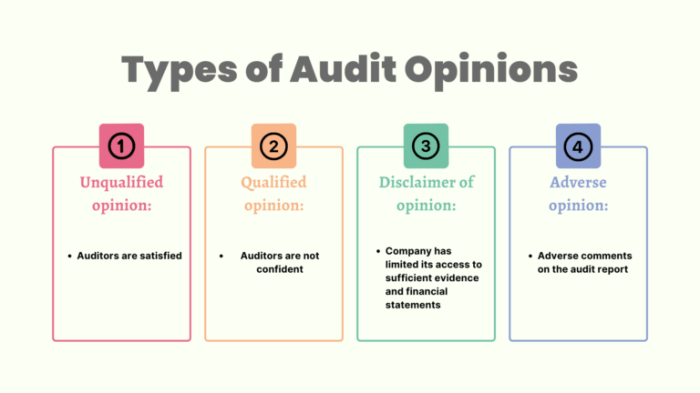
Investors can review the auditor’s report, look for any significant audit findings or qualifications, and research the auditor’s reputation and independence.