Navigating a financial audit can feel daunting, but with proper preparation, it can be a smooth and even beneficial process. This guide provides a comprehensive overview of the steps involved, from understanding the audit process itself to mastering effective communication with the audit team. We’ll cover essential record-keeping practices, the importance of robust internal controls, and strategies for responding to auditor inquiries.
By the end, you’ll feel confident in your ability to approach an audit with preparedness and assurance.
Understanding the intricacies of financial auditing is crucial for maintaining financial health and ensuring compliance. This guide is designed to demystify the process, providing practical advice and actionable steps to ensure a successful audit. Whether you’re a small business owner or part of a larger corporation, the principles Artikeld here will empower you to navigate the audit process effectively and minimize potential disruptions.
Understanding the Audit Process
A financial audit is a systematic and independent examination of an organization’s financial statements. Understanding the process is crucial for both the audited entity and the audit team to ensure a smooth and efficient audit. This involves knowing the various stages, the roles of each party involved, and the step-by-step procedures followed.
Stages of a Financial Audit
The financial audit process typically unfolds in several distinct phases. These phases are interconnected and build upon each other, culminating in the issuance of an audit report. A thorough understanding of each stage ensures preparedness and efficient collaboration.
Roles and Responsibilities
The audit process involves two key players: the audit team and the client (the organization being audited). Each party has specific responsibilities that must be fulfilled to ensure the audit’s integrity and effectiveness. Clear communication and cooperation between these parties are paramount for a successful audit.
- Audit Team: The audit team, typically composed of certified public accountants (CPAs), is responsible for planning the audit, gathering and evaluating evidence, and forming an opinion on the fairness of the financial statements. Their responsibilities include adhering to professional standards, maintaining independence, and documenting all procedures performed.
- Client: The client’s responsibilities include providing access to all relevant financial records and information, facilitating communication with the audit team, and addressing any queries raised during the audit. This includes providing necessary personnel to answer questions and facilitating access to physical assets if required.
Step-by-Step Guide to a Typical Financial Audit
A typical financial audit follows a structured approach. While the specifics may vary depending on the size and complexity of the organization, the overall process remains consistent.
- Planning: The audit team initially plans the scope and objectives of the audit, considering the organization’s risk profile and industry specifics. This includes establishing a budget and timeline.
- Risk Assessment: The team identifies and assesses the inherent and control risks associated with the organization’s financial reporting. This helps determine the areas requiring more detailed scrutiny.
- Internal Controls Testing: The audit team tests the effectiveness of the client’s internal controls over financial reporting. This helps evaluate the reliability of the financial information.
- Substantive Procedures: The team performs substantive procedures, such as testing transactions, balances, and disclosures, to gather sufficient evidence to support their opinion on the financial statements.
- Reporting: Finally, the audit team prepares and issues an audit report, expressing an opinion on the fairness of the financial statements, in accordance with generally accepted auditing standards (GAAS).
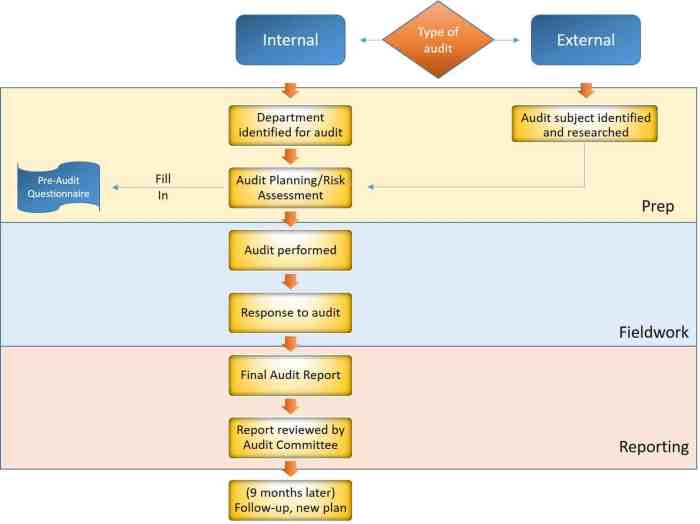
Flowchart of the Audit Process
A flowchart visually represents the sequential steps involved in a financial audit. Imagine a flowchart starting with a rectangle labeled “Audit Planning,” followed by a diamond representing a decision point (“Risk Assessment Complete?”). If yes, it proceeds to a rectangle “Internal Controls Testing,” and if no, it loops back to further risk assessment. Subsequent rectangles would depict “Substantive Procedures,” “Reporting,” and finally, “Audit Report Issued.” The flowchart demonstrates the iterative nature of the process, with feedback loops and potential revisions at each stage.
The overall shape resembles a continuous loop, highlighting the cyclical nature of the audit process, with each audit informing the planning of future audits.
Preparing Financial Records
A well-organized and meticulously maintained set of financial records is crucial for a smooth and efficient audit. Thorough preparation significantly reduces the time and effort required during the audit process, minimizing disruptions to your business operations and ensuring a positive outcome. This section details best practices for preparing your financial records for an audit.Preparing accurate and complete financial records is not merely a matter of compliance; it’s a fundamental aspect of good business management.
Accurate records provide a clear picture of your company’s financial health, enabling informed decision-making and facilitating effective strategic planning. Furthermore, maintaining complete documentation helps prevent disputes and ensures transparency in your financial dealings.
Organizing and Maintaining Financial Records
Effective record-keeping involves a systematic approach to organizing and storing financial documents. A well-structured filing system, whether physical or digital, is essential for quick and easy retrieval of information during the audit. This includes categorizing documents by type (e.g., invoices, receipts, bank statements), date, and relevant account. Regularly backing up digital records is also critical to prevent data loss.
Consider using cloud-based storage for added security and accessibility. Implementing a robust chart of accounts is vital for accurate categorization and reporting. This structured system allows for easy tracking of income, expenses, and assets, providing a clear financial overview.
Importance of Accurate and Complete Documentation
Accurate and complete documentation is paramount for a successful audit. Missing or inaccurate information can delay the audit process, lead to misunderstandings, and potentially result in adverse findings. Complete documentation provides auditors with the necessary evidence to verify the accuracy of your financial statements and ensure compliance with accounting standards. This includes supporting documentation for all transactions, such as invoices, receipts, and bank statements.
Maintaining detailed records minimizes the risk of discrepancies and strengthens the credibility of your financial reports. For example, a missing invoice could lead to an understatement of expenses, while an inaccurate entry could distort your profit margin.
Common Errors in Financial Record-Keeping and Solutions
Several common errors can hinder a smooth audit. These include inaccurate data entry, missing supporting documentation, inconsistent record-keeping practices, and a lack of proper reconciliation. Inaccurate data entry can lead to significant discrepancies in financial statements. Solutions include implementing double-entry bookkeeping systems, using accounting software with built-in error checks, and regular review of entries by a second person.
Missing supporting documentation can create uncertainty about the legitimacy of transactions. Solutions involve establishing a system for securely storing and retrieving all relevant documents. Inconsistent record-keeping practices, such as using different methods for recording similar transactions, can lead to confusion and inconsistencies. Solutions include standardizing procedures and training staff on consistent practices. Finally, a lack of proper reconciliation between bank statements and accounting records can reveal discrepancies and errors.
Solutions involve performing regular bank reconciliations and investigating any discrepancies promptly.
Essential Documents for a Smooth Audit
Preparing a comprehensive checklist of essential documents is a proactive step to ensure a smooth audit. This checklist should include, but not be limited to, the following:
- Balance sheets for the period under review
- Income statements for the period under review
- Cash flow statements for the period under review
- General ledger
- Bank statements and reconciliations
- Supporting documentation for all significant transactions (invoices, receipts, contracts)
- Fixed asset register
- Payroll records
- Tax returns
- Chart of accounts
Having these documents readily available and organized significantly streamlines the audit process. It demonstrates a commitment to transparency and good financial management, fostering a collaborative and efficient relationship with the auditors.
Internal Controls and Compliance
Robust internal controls are the cornerstone of a sound financial system, acting as a crucial safeguard against both unintentional errors and deliberate fraud. A well-designed system of internal controls provides assurance to stakeholders that financial reporting is accurate and reliable, enhancing the credibility of the organization and fostering trust with investors, creditors, and regulatory bodies. The absence or weakness of such controls can lead to significant financial losses, reputational damage, and even legal repercussions.
The Significance of Internal Controls in Preventing Fraud and Errors
Effective internal controls are designed to mitigate risks throughout the financial cycle. They aim to prevent errors from occurring in the first place, detect errors that do occur, and correct them promptly. Similarly, they deter fraudulent activities by creating an environment where such actions are difficult to perpetrate and easily detectable. This includes segregation of duties, authorization procedures, and regular reconciliations, all contributing to a lower risk profile.
For example, a system where one person is responsible for receiving payments and another for recording them significantly reduces the opportunity for embezzlement. Regular bank reconciliations help detect discrepancies and potential fraudulent transactions.
Internal Control Frameworks: A Comparison
Several frameworks provide guidance on establishing and maintaining effective internal controls. The Committee of Sponsoring Organizations of the Treadway Commission (COSO) framework is widely recognized as a leading standard. COSO defines internal control as a process, effected by an entity’s board of directors, management, and other personnel, designed to provide reasonable assurance regarding the achievement of objectives relating to operations, reporting, and compliance.
Other frameworks, such as the COBIT framework (Control Objectives for Information and related Technologies), focus more specifically on IT controls. While COSO offers a comprehensive approach encompassing all aspects of an organization, COBIT provides a more targeted framework for managing and controlling information technology risks. The key difference lies in their scope: COSO is broader, encompassing all organizational objectives, while COBIT focuses specifically on IT governance and management.
Examples of Effective Internal Controls for Various Financial Processes
Implementing effective internal controls requires a tailored approach based on the specific risks faced by an organization. Here are a few examples:
| Financial Process | Internal Control | Benefit | Example |
|---|---|---|---|
| Cash Handling | Segregation of duties (handling cash vs. recording cash) | Reduces risk of theft or embezzlement | Different employees handle cash receipts and record them in the accounting system. |
| Accounts Payable | Three-way match (purchase order, invoice, receiving report) | Ensures accuracy of payments and prevents duplicate payments | Invoices are only processed if all three documents match. |
| Inventory Management | Regular physical inventory counts | Detects discrepancies between recorded and actual inventory levels | Physical inventory is counted and compared to the accounting records at least annually. |
Common Compliance Requirements and Their Implications
Compliance with various regulations is crucial for organizations to avoid penalties and maintain a positive reputation. Failure to comply can result in fines, legal action, and damage to the company’s image.
| Compliance Requirement | Description | Implications of Non-Compliance | Example |
|---|---|---|---|
| Sarbanes-Oxley Act (SOX) | U.S. law requiring publicly traded companies to maintain strong internal controls and accurate financial reporting. | Significant fines, legal action, delisting from stock exchanges. | Failure to comply with SOX can lead to significant financial penalties and reputational damage. |
| General Data Protection Regulation (GDPR) | EU regulation protecting personal data. | Heavy fines for data breaches and non-compliance. | Companies must implement strong data security measures to comply with GDPR. |
| International Financial Reporting Standards (IFRS) | Globally accepted accounting standards. | Inaccurate financial reporting, investor distrust, difficulty attracting investment. | Failure to follow IFRS can lead to misstated financial reports and loss of investor confidence. |
Responding to Auditor Requests
Responding effectively to auditor requests is crucial for a smooth and efficient audit process. A well-organized and timely response demonstrates transparency and cooperation, minimizing delays and potential misunderstandings. Clear communication is key to ensuring the auditors have all the information they need to complete their work accurately and efficiently.Effective communication with the audit team involves providing clear, concise, and accurate information in a timely manner.
This includes responding promptly to all inquiries, providing supporting documentation as requested, and maintaining open communication channels throughout the audit. Proactive communication can prevent minor issues from escalating into major problems.
Typical Auditor Requests and Responses
Auditors typically request various types of information throughout the audit process. Understanding the common requests and how to respond appropriately is vital for a successful audit. This section details common requests and examples of effective responses.
- Request: Supporting documentation for a specific transaction. Response: Provide a copy of the invoice, receipt, bank statement, and any other relevant documents clearly indicating the date, amount, and parties involved. Organize the documents logically and clearly label them.
- Request: Explanation of a significant variance in a particular account. Response: Provide a detailed explanation, including supporting calculations and documentation, that clearly explains the reasons for the variance. If the variance is due to an error, clearly state the error and the steps taken to correct it.
- Request: Confirmation of the existence of a specific asset. Response: Provide documentation such as purchase orders, ownership certificates, or appraisals to confirm the asset’s existence and value. Include any relevant details about the asset’s location and condition.
- Request: Clarification on a specific accounting policy. Response: Refer to the company’s accounting policy manual and provide a clear and concise explanation of the relevant policy. If the policy has been changed, explain the reasons for the change and its impact on the financial statements.
Preparing and Presenting Supporting Documentation
Providing well-organized and comprehensive supporting documentation is essential for addressing auditor findings. This demonstrates transparency and helps the auditors verify the accuracy of the financial statements. Poorly presented documentation can lead to delays and further inquiries, hindering the audit process.Effective documentation should be easily accessible, well-organized, and clearly labeled. Each document should be clearly linked to the specific audit finding or inquiry it addresses.
For example, if an auditor questions a specific expense, the supporting documentation should clearly show the purpose of the expense, the date it was incurred, and the payment method used. Using a standardized filing system for documentation ensures easy retrieval and enhances efficiency during the audit. This could include a dedicated audit folder with clearly labeled subfolders for each area under review.
Post-Audit Procedures
The completion of a financial audit marks a significant milestone, but the process doesn’t end there. Post-audit procedures are crucial for ensuring the effectiveness of the audit and for improving the organization’s financial management practices. These procedures involve reviewing the audit findings, implementing corrective actions, and planning for future audits.Addressing audit findings and recommendations is paramount to improving the organization’s financial health and mitigating future risks.
Failure to adequately address these issues could lead to repeated findings in subsequent audits, potentially impacting the organization’s reputation and financial stability. A proactive approach to addressing audit recommendations demonstrates a commitment to good governance and transparency.
Addressing Audit Findings and Recommendations
This involves a thorough review of the auditor’s report, identifying all findings and recommendations. Each finding should be analyzed to determine its severity and potential impact. A prioritized list of findings should be created, focusing first on critical issues that pose immediate risks. For each finding, a responsible party should be assigned, and a clear action plan, including deadlines and metrics for success, should be developed and documented.
Regular progress updates should be provided to management. For example, if the audit reveals weaknesses in inventory management leading to discrepancies, the action plan might include implementing a new inventory tracking system and providing staff training on its use within a specified timeframe.
Implementing Corrective Actions and Improving Internal Controls
Once action plans are in place, their implementation is critical. This involves not only fixing the immediate problems identified by the audit but also strengthening internal controls to prevent similar issues from recurring. Effective corrective actions often require changes to policies, procedures, and systems. Regular monitoring of implemented controls is crucial to ensure their effectiveness. For instance, if the audit highlighted a weakness in segregation of duties, the corrective action might involve restructuring job responsibilities and implementing regular reviews of access permissions.
This would be followed by ongoing monitoring to ensure the new structure remains effective.
Planning for Future Audit Preparation
The lessons learned from a completed audit should inform future audit preparation. This involves analyzing the audit report to identify areas where improvements can be made in the organization’s financial processes and controls. A plan should be developed to address identified weaknesses and enhance internal controls. This might include updating financial policies, improving documentation, or investing in new technologies to streamline financial processes.
For example, if the audit revealed challenges in timely financial reporting, the future preparation plan could involve implementing new reporting software and providing additional training to staff on its use. This proactive approach ensures that future audits are more efficient and less likely to uncover significant issues.
Financial Advice, Auditing, Goals, and Planning
Financial advice, auditing, goal setting, and planning are interconnected elements crucial for achieving robust financial health and successfully navigating the audit process. Understanding their interplay is essential for both individuals and businesses. This section explores the relationships between these components and how they contribute to a stronger financial position.
The Relationship Between Financial Advice and Financial Auditing
Financial advice and financial auditing, while distinct, are complementary processes. Financial advisors help individuals and businesses establish financial goals, develop strategies to achieve those goals, and manage their financial resources effectively. Auditors, on the other hand, independently examine financial records to ensure their accuracy, completeness, and compliance with accounting standards. Effective financial advice can significantly reduce the risks and complexities associated with an audit by ensuring the financial records are well-maintained and compliant.
For example, a financial advisor might recommend implementing robust accounting software and internal controls, directly improving the efficiency and accuracy of the audit process. Conversely, the insights gained from an audit can inform future financial advice, highlighting areas needing improvement in financial planning and management.
Financial Goals and Financial Planning: A Comparison
Financial goals represent the desired outcomes an individual or business wants to achieve, such as retirement security, purchasing a home, or expanding a business. Financial planning is the process of developing and implementing a strategy to achieve these goals. Financial goals provide the direction, while financial planning provides the roadmap. For instance, a financial goal might be to retire comfortably at age 65.
The financial plan would Artikel specific steps, such as saving a certain amount each month, investing in specific asset classes, and managing expenses effectively, to achieve that goal. Financial goals are the destination; financial planning is the journey.
Mitigating Audit Risks Through Financial Planning
Proactive financial planning can significantly reduce the risks identified during a financial audit. By implementing sound accounting practices, maintaining accurate records, and establishing robust internal controls, businesses can minimize the likelihood of audit findings and potential penalties. For example, a comprehensive financial plan that includes regular reconciliation of bank statements and thorough documentation of transactions can prevent discrepancies and inconsistencies that might raise red flags during an audit.
Furthermore, incorporating risk management strategies into the financial plan can help identify and address potential vulnerabilities before they become significant problems.
Improving Financial Health and Audit Preparedness Through Financial Advice
Financial advice can play a pivotal role in improving overall financial health and preparing for future audits. A qualified financial advisor can help individuals and businesses establish realistic financial goals, develop a comprehensive financial plan, and implement strategies for managing debt, saving, and investing. This improved financial organization and clarity significantly simplifies the audit process. For example, a financial advisor might recommend using budgeting software to track income and expenses, which not only improves financial health but also makes it easier to provide accurate and readily available financial data during an audit.
Furthermore, advice on tax planning and compliance can help minimize tax liabilities and avoid potential audit issues related to tax reporting. In essence, a well-structured financial plan, guided by professional advice, acts as a preventative measure, minimizing the stress and potential issues during a financial audit.
Preparing for a financial audit is a proactive approach to ensuring financial transparency and operational efficiency. By implementing the strategies and best practices discussed, you not only streamline the audit process but also identify areas for improvement within your financial management. This proactive approach fosters stronger internal controls, reduces the risk of errors and fraud, and ultimately contributes to the long-term financial health and stability of your organization.
Remember, a well-prepared audit is an opportunity for growth and improvement.
General Inquiries
What happens if I don’t have all the requested documents for the audit?
Communicate with the auditors immediately. Explain the situation and provide a timeline for obtaining the missing documents. Proactive communication is key.
How long does a financial audit typically take?
The duration varies significantly depending on the size and complexity of the organization and its financial records. It can range from a few weeks to several months.
What if the auditors find discrepancies in my financial records?
Cooperate fully with the auditors to address the discrepancies. Provide explanations and supporting documentation. This demonstrates transparency and a commitment to accuracy.
Can I hire an independent consultant to help me prepare for the audit?
Yes, many businesses find it beneficial to engage an independent consultant who specializes in audit preparation. They can provide expert guidance and support.