Securing a comfortable retirement requires careful planning and proactive financial management. This guide delves into the essential aspects of building a robust retirement savings plan, from defining your retirement goals and choosing appropriate investment strategies to managing expenses and navigating the complexities of various retirement accounts. We’ll explore diverse approaches to ensure you’re well-prepared for this significant life stage.
Understanding your risk tolerance, maximizing tax advantages, and diversifying your investments are crucial elements we’ll unpack. We’ll also examine the role of financial advice and auditing in maintaining the integrity of your plan, ensuring it aligns with your evolving needs and circumstances throughout your life.
Defining Retirement Savings Goals
Planning for retirement requires a clear understanding of your desired lifestyle and the financial resources needed to support it. This involves setting realistic and achievable savings goals, considering various factors like your current income, expenses, and anticipated future needs. Failing to adequately define these goals can lead to insufficient savings and a less comfortable retirement.
Different retirement scenarios demand varying levels of financial preparedness. Consider a simple example: a retiree choosing a low-key lifestyle might comfortably live on $30,000 annually, primarily relying on Social Security and a modest nest egg. Conversely, an individual aiming for a more active retirement, including extensive travel and luxury amenities, could easily require $100,000 or more annually, necessitating a significantly larger retirement fund.
Retirement Lifestyle Scenarios and Cost Estimates
Estimating retirement costs requires careful consideration of several key expenses. These include housing (mortgage payments, rent, property taxes, maintenance), healthcare (insurance premiums, medical expenses, long-term care), food, transportation, utilities, entertainment, and travel. It’s crucial to account for inflation, as the cost of living will likely increase over time. For example, a comfortable retirement in a specific location today may cost X dollars annually, but in 20 years, due to inflation, that same lifestyle may require 1.5X or 2X dollars.
Furthermore, unforeseen medical expenses can significantly impact retirement budgets, highlighting the importance of robust health insurance and emergency funds.
Calculating Target Retirement Savings Amount
Determining your target retirement savings amount involves several methods. A common approach is the “replacement ratio” method, which estimates the percentage of your pre-retirement income needed to maintain your desired lifestyle in retirement. This ratio typically ranges from 70% to 90%, depending on individual circumstances. For example, if your pre-retirement income is $80,000 annually, and you aim for an 80% replacement ratio, your target annual retirement income would be $64,000.
To determine the total savings needed, you can utilize various online retirement calculators or consult a financial advisor, factoring in your expected investment returns and the duration of your retirement.
The formula for calculating the needed retirement savings is complex and depends on factors such as investment returns, inflation, and the length of retirement. However, a simplified approach involves dividing your desired annual retirement income by your estimated annual rate of return to determine the necessary savings.
Adjusting Savings Goals Based on Life Events
Life throws curveballs. Unexpected events such as job loss, illness, or family emergencies can significantly impact your retirement savings plan. It’s essential to regularly review and adjust your goals based on these unforeseen circumstances. For example, a job loss might necessitate a temporary reduction in savings contributions, or an unexpected medical expense may require drawing down some savings.
However, it’s crucial to develop a plan to replenish any withdrawals and get back on track towards your long-term goals. Similarly, a significant salary increase provides an opportunity to boost your retirement savings contributions, accelerating your progress towards financial security.
Investment Strategies for Retirement
Planning your retirement investments requires a thoughtful approach, considering your time horizon, risk tolerance, and financial goals. A well-diversified portfolio, strategically allocated across various asset classes, is crucial for maximizing returns while mitigating risk. This section will explore different investment vehicles and how to tailor a strategy to your individual circumstances.
Comparing Investment Vehicles for Retirement
Several investment vehicles offer distinct advantages and disadvantages for retirement savings. Stocks represent ownership in a company and offer the potential for high returns but also carry significant risk. Bonds, on the other hand, are debt instruments issued by corporations or governments, generally considered less risky than stocks but with lower potential returns. Mutual funds pool money from multiple investors to invest in a diversified portfolio of stocks, bonds, or other assets, offering professional management and diversification benefits.
Exchange-Traded Funds (ETFs) are similar to mutual funds but trade on stock exchanges like individual stocks, providing greater flexibility.The choice of investment vehicle depends heavily on individual circumstances and risk tolerance. Younger investors with a longer time horizon may be more comfortable with higher-risk investments like stocks, aiming for potentially higher returns to compensate for inflation. Older investors closer to retirement may prefer lower-risk options like bonds to preserve capital.
Risk Tolerance Assessment and Investment Strategy
A crucial step in retirement planning is assessing your risk tolerance. This involves understanding your comfort level with potential investment losses. Several factors influence risk tolerance, including your age, financial situation, investment goals, and personality. A thorough risk assessment typically involves questionnaires or discussions with a financial advisor to gauge your willingness to accept risk in exchange for potentially higher returns.High-risk tolerance individuals may allocate a larger portion of their portfolio to stocks and other growth-oriented assets.
Conversely, those with low-risk tolerance might favor a more conservative approach, prioritizing capital preservation with a higher allocation to bonds and lower-risk investments. The results of this assessment directly inform the selection of an appropriate investment strategy. For example, a high-risk tolerance individual might invest heavily in emerging market equities, while a low-risk tolerance individual might favor government bonds and certificates of deposit.
Sample Diversified Investment Portfolio (45-Year-Old, Moderate Risk Tolerance)
A 45-year-old with a moderate risk tolerance can benefit from a diversified portfolio that balances growth potential with risk mitigation. The following table illustrates a possible allocation:
| Asset Class | Allocation Percentage | Risk Level | Expected Return (Annualized, illustrative) |
|---|---|---|---|
| US Large-Cap Stocks | 30% | Moderate | 8-10% |
| US Small-Cap Stocks | 15% | Moderate-High | 10-12% |
| International Stocks | 15% | Moderate-High | 9-11% |
| Investment-Grade Bonds | 30% | Low | 3-5% |
| Real Estate (REITs) | 10% | Moderate | 6-8% |
Disclaimer: The expected returns shown are illustrative and not guaranteed. Actual returns will vary depending on market conditions. This is a sample portfolio and may not be suitable for all investors. It’s crucial to consult with a qualified financial advisor to determine the most appropriate investment strategy for your individual circumstances.
Planning for retirement is a journey, not a destination. By carefully considering your goals, diversifying your investments, and regularly reviewing your strategy, you can significantly increase your chances of achieving a financially secure and fulfilling retirement. Remember that seeking professional financial advice can provide invaluable support and guidance throughout this process, ensuring you make informed decisions aligned with your unique circumstances.
Clarifying Questions
What is the difference between a traditional IRA and a Roth IRA?
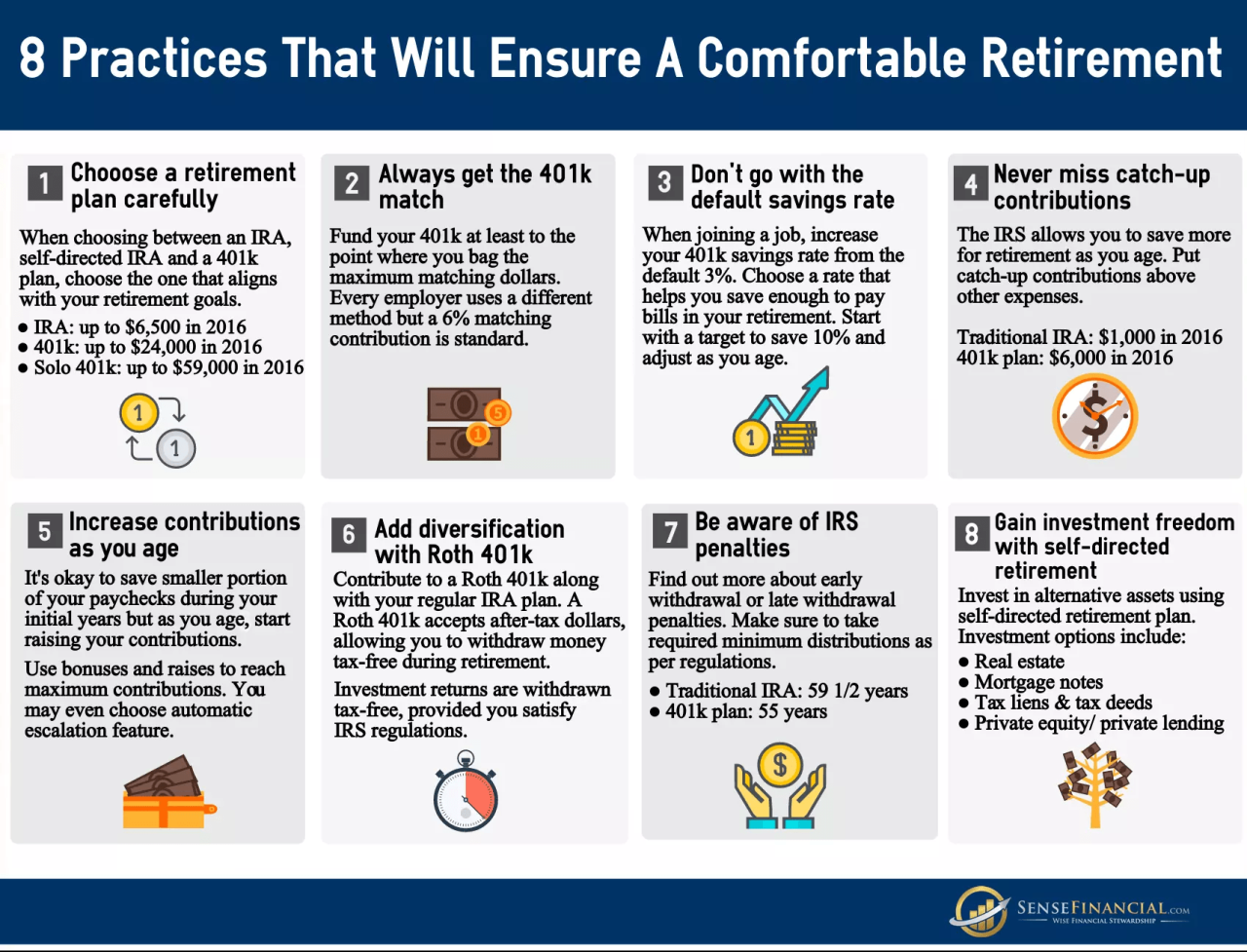
A traditional IRA offers tax deductions on contributions, but withdrawals are taxed in retirement. A Roth IRA doesn’t offer upfront tax deductions, but withdrawals are tax-free in retirement.
How much should I be saving for retirement?
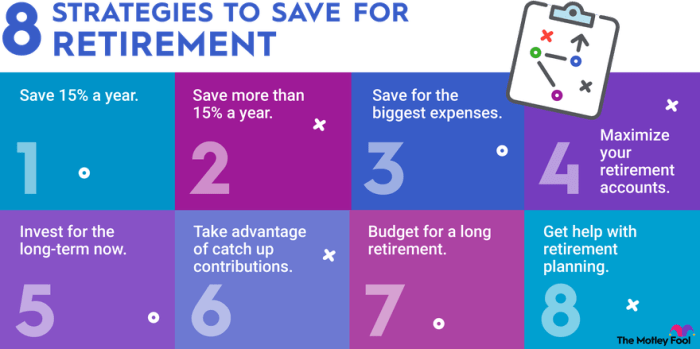
The amount varies depending on your lifestyle, income, and retirement goals. A general rule of thumb is to aim for saving at least 10-15% of your pre-tax income.
When should I start withdrawing from my retirement accounts?
You can typically begin withdrawing from traditional IRAs at age 59 1/2 without penalty, though early withdrawals may incur taxes. Roth IRA withdrawals are generally tax-free after age 59 1/2, provided the account has been open for at least five years.
What happens if I outlive my retirement savings?
This is a risk for everyone. Careful planning, including considering potential longevity and inflation, is crucial. Supplementing retirement income with part-time work or downsizing are strategies to mitigate this risk.