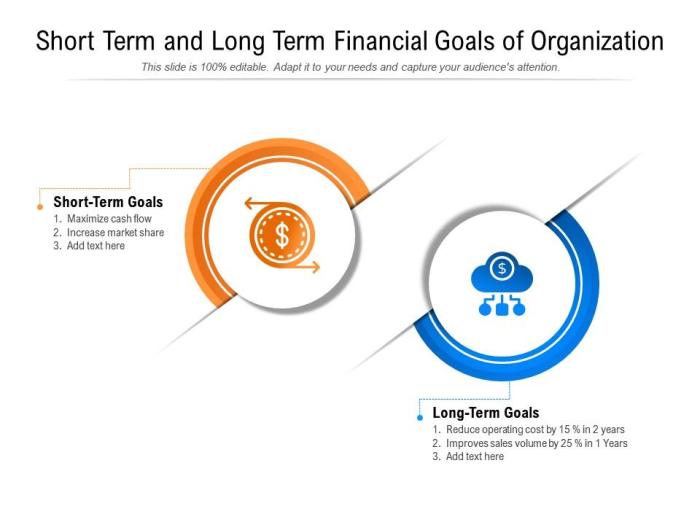
Successfully navigating the financial landscape requires a delicate balance between immediate needs and long-term aspirations. This guide explores the art of harmonizing short-term financial goals, such as building an emergency fund or planning a vacation, with the larger objectives of securing a comfortable retirement or owning a home. We’ll delve into practical strategies for budgeting, investing, managing debt, and regularly reviewing your financial plan to ensure it remains aligned with your evolving circumstances.
We will cover key aspects of financial planning, including creating effective budgets that allocate resources for both immediate and long-term goals, exploring diverse investment options to match your risk tolerance and time horizon, and developing strategies for managing debt while building wealth. Understanding the interplay between short-term and long-term planning is crucial for achieving lasting financial security and peace of mind.
Budgeting and Allocation of Resources
A well-structured budget is the cornerstone of successful financial planning, enabling individuals to effectively balance immediate needs with long-term financial goals. It provides a clear roadmap for managing income and expenses, ensuring that sufficient funds are allocated to both short-term priorities and long-term investments. Without a budget, it’s easy to overspend on immediate gratification, hindering progress toward significant financial objectives.Budgeting allows for a proactive approach to financial management, rather than a reactive one.
By meticulously tracking income and expenses, individuals gain valuable insights into their spending habits, identifying areas where adjustments can be made to optimize resource allocation. This proactive approach facilitates the attainment of both short-term and long-term financial goals, fostering a sense of control and confidence in one’s financial future.
Creating a Budget that Accommodates Short-Term and Long-Term Needs
A successful budget integrates both immediate needs and future aspirations. This requires careful consideration of various expenses and savings targets. The key is to prioritize needs and wants, allocating resources strategically to meet both current obligations and future financial objectives. A balanced approach involves identifying essential expenses, such as housing, food, and transportation, and allocating a portion of income towards these necessities.
Simultaneously, a significant portion should be dedicated to savings and investments for long-term goals like retirement or a down payment on a house.
Methods for Allocating Funds to Savings and Investments
Several methods exist for allocating funds effectively. One popular approach is the 50/30/20 rule, where 50% of income is allocated to needs, 30% to wants, and 20% to savings and debt repayment. However, this is a guideline, and the ideal percentages may vary depending on individual circumstances and financial goals. Diversification across various savings accounts and investment vehicles is also crucial.
This could include high-yield savings accounts for short-term goals, retirement accounts (like 401(k)s or IRAs) for long-term retirement planning, and investment accounts for long-term growth. The allocation strategy should align with the individual’s risk tolerance and time horizon.
Sample Budget: Allocation of Funds for Short-Term and Long-Term Goals
The following sample budget demonstrates a possible allocation of funds. It’s important to remember that this is a template, and individuals should adjust percentages based on their specific needs and goals.
- Housing: 30%
- Food: 15%
- Transportation: 10%
- Utilities: 5%
- Healthcare: 5%
- Personal Spending: 10%
- Short-Term Savings (Emergency Fund): 5%
- Long-Term Savings (Retirement): 10%
- Long-Term Investments: 10%
This sample budget allocates a significant portion (30%) to housing, reflecting its importance as a primary need. A substantial amount (20%) is also dedicated to long-term savings and investments, emphasizing the importance of securing future financial well-being. The remaining percentages are allocated to other essential expenses and personal spending, ensuring a balance between immediate needs and future planning.
This example illustrates a balanced approach, but individual adjustments are necessary for personalized effectiveness.
Investment Strategies for Balanced Growth
Investing is crucial for achieving long-term financial goals, such as retirement planning, purchasing a home, or funding your children’s education. A well-structured investment strategy, balanced between short-term needs and long-term aspirations, allows you to grow your wealth while maintaining access to funds for immediate expenses. This balance requires careful consideration of risk tolerance and time horizon.
The Role of Investment in Long-Term Financial Goals
Investments provide the potential for your money to grow faster than inflation, thereby increasing your purchasing power over time. This growth is essential for meeting long-term financial objectives that often require significant capital accumulation. For example, a young professional aiming for early retirement needs a robust investment strategy to generate substantial returns over several decades. Without investing, achieving such goals solely through savings would likely require significantly longer timeframes and may be unattainable.
Different investment vehicles offer varying levels of risk and potential returns, aligning with individual financial goals and risk tolerance.
Investment Options for Short-Term and Long-Term Horizons
A diversified investment portfolio is generally recommended, incorporating assets suitable for both short-term and long-term goals.Short-term investments typically offer high liquidity and lower risk, prioritizing capital preservation and accessibility. Examples include high-yield savings accounts, money market accounts, and short-term certificates of deposit (CDs). These options provide a safe haven for emergency funds or money needed within the next few years.Long-term investments, on the other hand, focus on capital appreciation and typically involve higher risk.
Stocks, bonds, and real estate are common long-term investment choices. Stocks represent ownership in companies and offer potentially high returns but also carry greater volatility. Bonds, representing loans to governments or corporations, generally offer lower returns but are considered less risky than stocks. Real estate investments, such as purchasing property, can provide both income (rent) and capital appreciation but require significant capital outlay and can be illiquid.
Risk Tolerance and Potential Returns of Investment Strategies
The risk associated with an investment is directly related to its potential return. Higher-risk investments, such as individual stocks or emerging market funds, offer the possibility of substantial returns but also carry a greater chance of loss. Lower-risk investments, such as government bonds or high-yield savings accounts, offer lower potential returns but are generally safer. An individual’s risk tolerance, which depends on factors such as age, financial situation, and personal preferences, should guide their investment choices.
Younger investors with a longer time horizon can generally tolerate more risk, while older investors closer to retirement often prioritize capital preservation.
Comparison of Investment Options
| Investment Option | Risk Level | Potential Return | Liquidity |
|---|---|---|---|
| High-Yield Savings Account | Low | Low | High |
| Money Market Account | Low | Low to Moderate | High |
| Short-Term CDs | Low | Low to Moderate | Moderate |
| Bonds (Government) | Low to Moderate | Moderate | Moderate |
| Stocks (Large-Cap) | Moderate to High | Moderate to High | High |
| Real Estate | Moderate to High | Moderate to High | Low |
Managing Debt and Financial Risks
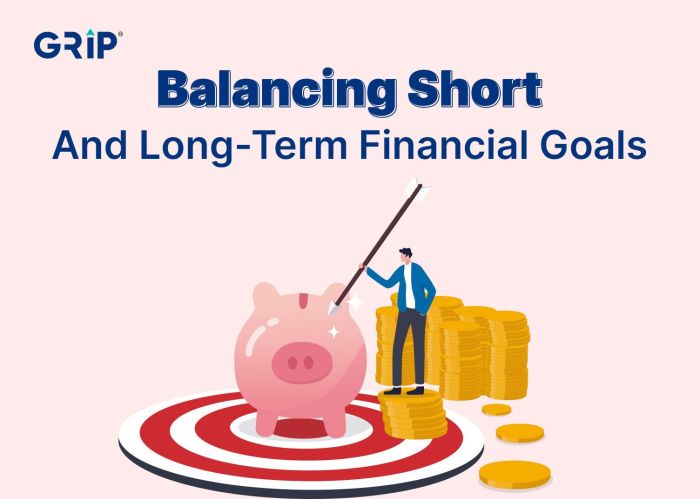
Effective debt management and risk mitigation are crucial for achieving both short-term financial stability and long-term financial security. Ignoring these aspects can significantly hinder progress towards financial goals, leading to potential setbacks and increased stress. A balanced approach requires a proactive strategy that considers both immediate needs and future aspirations.Successfully navigating the complexities of personal finance necessitates a comprehensive understanding of debt management and risk mitigation strategies.
This involves not only paying down existing debt but also proactively avoiding the accumulation of new debt, diversifying investments, and implementing strategies to protect against unforeseen financial challenges. Ignoring these aspects can have serious consequences, potentially jeopardizing short-term stability and long-term financial security.
Strategies for Managing Debt
Effective debt management involves a multifaceted approach that considers the type of debt, interest rates, and overall financial circumstances. A strategic plan should aim to minimize interest payments while maintaining a healthy credit score. This requires discipline and a commitment to consistent repayment.
- Prioritize high-interest debt: Focus on paying down debts with the highest interest rates first, such as credit card debt, to minimize overall interest payments.
- Debt consolidation: Consider consolidating high-interest debts into a lower-interest loan, simplifying payments and potentially reducing the overall cost of borrowing. This could involve a balance transfer credit card or a personal loan.
- Negotiate with creditors: Contact creditors to discuss options for lowering interest rates or modifying payment plans if facing financial hardship. Many creditors are willing to work with borrowers to avoid defaults.
- Budgeting and expense tracking: Create a detailed budget to identify areas where expenses can be reduced to free up more money for debt repayment. Utilize budgeting apps or spreadsheets to monitor spending habits effectively.
- Increase income: Explore opportunities to increase income through a side hustle, freelance work, or a higher-paying job to accelerate debt repayment.
Potential Financial Risks of Unbalanced Financial Planning
Unbalanced financial planning, prioritizing only short-term gains or neglecting long-term goals, exposes individuals to significant financial risks. These risks can manifest in various forms, leading to financial instability and potentially severe consequences.
- Inability to meet long-term goals: Neglecting long-term savings and investments can hinder the ability to achieve significant financial goals, such as retirement planning, homeownership, or children’s education.
- Increased susceptibility to financial emergencies: Lack of emergency savings can leave individuals vulnerable to unexpected events, such as job loss or medical emergencies, potentially leading to debt accumulation and financial hardship.
- High levels of consumer debt: Overreliance on credit cards and other high-interest debt can result in unsustainable debt burdens, impacting credit scores and overall financial well-being.
- Missed investment opportunities: Focusing solely on short-term needs may lead to missed opportunities for long-term investment growth, limiting potential wealth accumulation.
- Financial instability in retirement: Insufficient retirement savings can result in financial insecurity during retirement, potentially requiring reliance on government assistance or reduced living standards.
The Importance of Diversifying Investments
Diversification is a cornerstone of sound investment strategy, aiming to reduce the overall risk of investment losses. By spreading investments across different asset classes (stocks, bonds, real estate, etc.), investors can mitigate the impact of poor performance in any single asset. This approach helps to balance risk and reward, promoting long-term growth while minimizing the potential for significant losses.For example, during a market downturn, a diversified portfolio may experience some losses, but these losses will likely be smaller than if all investments were concentrated in a single asset class, such as stocks.
The inclusion of less volatile assets, like bonds, can help to cushion the impact of market fluctuations.
A Debt Reduction Plan
A comprehensive debt reduction plan requires a strategic approach that balances immediate needs with long-term financial security. This plan prioritizes high-interest debt while ensuring sufficient funds for essential expenses and emergency savings.
- Assess your current financial situation: Calculate your total debt, interest rates, and monthly payments. Analyze your income and expenses to determine how much money you can allocate to debt repayment.
- Create a realistic budget: Develop a detailed budget that tracks income and expenses, identifying areas for potential savings. Allocate funds specifically for debt repayment and emergency savings.
- Prioritize high-interest debt: Focus your repayment efforts on debts with the highest interest rates first, such as credit cards, to minimize the overall cost of borrowing.
- Explore debt consolidation options: Consider consolidating high-interest debts into a lower-interest loan to simplify payments and potentially reduce the overall cost of borrowing. This could involve a balance transfer credit card or a personal loan.
- Negotiate with creditors: Contact creditors to explore options for lowering interest rates or modifying payment plans if facing financial hardship. Many creditors are willing to work with borrowers to avoid defaults.
- Establish an emergency fund: Build an emergency fund to cover unexpected expenses, preventing the need to incur new debt during unforeseen circumstances. Aim for 3-6 months’ worth of living expenses.
- Monitor progress and adjust as needed: Regularly review your progress and adjust your plan as needed based on changes in your financial situation. Flexibility is key to successful debt reduction.
Regular Review and Adjustment of Financial Plans
A well-crafted financial plan is not a static document; it’s a living roadmap that requires regular attention and adjustments to remain effective. Life is dynamic, and your financial goals and circumstances will inevitably change over time. Consistent review and adaptation ensure your plan remains aligned with your evolving needs and aspirations, maximizing your chances of achieving both short-term and long-term financial success.Regular review of your financial plan is crucial for staying on track and adapting to unexpected circumstances.
Failing to do so can lead to missed opportunities and potentially serious financial setbacks. By proactively monitoring your progress and making necessary adjustments, you can maintain control of your finances and navigate life’s inevitable changes with greater confidence.
Methods for Tracking Progress
Tracking progress toward your financial goals requires a combination of monitoring and analysis. You should regularly review your budget to ensure you’re staying within spending limits and saving enough to meet your targets. For long-term goals like retirement, monitor the growth of your investments and adjust your contribution strategy as needed. Tools like budgeting apps, spreadsheet software, or financial planning software can significantly simplify this process, providing clear visualizations of your progress and highlighting areas needing attention.
For example, a simple spreadsheet can track monthly savings towards a down payment on a house, allowing you to see at a glance how much you’ve saved and how much further you need to go. Similarly, regularly checking investment account statements provides insights into the performance of your portfolio and its alignment with your long-term objectives.
Impact of Life Changes on Financial Plans
Significant life events often necessitate adjustments to your financial plan. A job loss, for instance, might require a drastic reduction in spending and a reevaluation of your savings goals. Marriage typically involves merging finances, necessitating a joint budgeting process and the creation of shared financial goals. Having children brings additional expenses related to childcare, education, and healthcare, which must be factored into your budget and savings strategy.
Unexpected medical expenses or a home repair can also necessitate adjustments. In each case, a flexible and adaptable plan allows you to navigate these changes smoothly, minimizing the negative impact on your overall financial well-being. For example, a couple planning for retirement might need to adjust their savings contributions if they unexpectedly have a child, requiring them to prioritize immediate expenses over long-term investments temporarily.
Checklist for Regular Financial Plan Reviews
Regular reviews are essential for ensuring your financial plan remains relevant and effective. A structured approach will help you identify areas for improvement and make necessary adjustments promptly. Here’s a checklist to guide your review process:
- Review your budget: Analyze your income and expenses to identify areas for improvement.
- Assess your progress towards short-term goals: Check your progress on saving for a down payment, paying off debt, or other short-term objectives.
- Evaluate your investment portfolio: Review your investment performance, asset allocation, and risk tolerance.
- Review your debt management strategy: Assess your debt levels, interest rates, and repayment plans.
- Assess your insurance coverage: Ensure your insurance policies adequately protect you and your family.
- Consider your estate planning documents: Review and update your will, power of attorney, and other relevant documents.
- Account for life changes: Adjust your plan to accommodate significant life events such as marriage, childbirth, job changes, or major medical expenses.
- Rebalance your portfolio as needed: Ensure your investments are still aligned with your risk tolerance and long-term goals.
- Seek professional advice if needed: Consult with a financial advisor if you need assistance with complex financial decisions.
Seeking Professional Financial Guidance
Navigating the complexities of personal finance can be challenging, even for those with a strong understanding of basic financial principles. Seeking professional financial guidance can significantly enhance your ability to achieve your financial goals, minimize risks, and optimize your financial well-being. A financial professional provides an objective perspective and specialized knowledge that can prove invaluable in making informed decisions.Professional financial advice, including financial auditing and planning, offers numerous benefits.
A financial advisor can help you create a comprehensive financial plan tailored to your specific circumstances, goals, and risk tolerance. This plan will typically encompass budgeting, investment strategies, debt management, and retirement planning. Furthermore, a financial auditor can provide an independent assessment of your financial health, identifying areas for improvement and potential risks. This dual approach – proactive planning and reactive auditing – creates a robust system for managing your finances.
Benefits of Professional Financial Advice
Engaging a financial professional offers several key advantages. They bring expertise in areas like investment management, tax planning, estate planning, and risk management. This specialized knowledge allows for more effective decision-making, potentially leading to greater returns and reduced financial stress. Their objective perspective can help you avoid emotional biases that often cloud judgment in financial matters. They can also provide valuable insights into complex financial products and strategies, ensuring you make informed choices aligned with your goals.
Finally, having a financial professional accountable for your financial plan can provide an extra layer of motivation and discipline to stick to your financial goals.
Situations Benefiting from Professional Financial Guidance
Several scenarios highlight the significant value of professional financial guidance. For example, individuals inheriting a substantial sum of money may need help navigating the tax implications and investment options to preserve and grow their wealth. Similarly, those facing significant life changes, such as marriage, divorce, or the birth of a child, often require assistance in adjusting their financial plans to accommodate these new circumstances.
Entrepreneurs starting a business need help with financial modeling, securing funding, and managing the financial aspects of their venture. Individuals nearing retirement require assistance in creating a retirement income plan that ensures they have enough funds to support their lifestyle. Finally, individuals with complex financial situations, such as significant debt or multiple investment accounts, will benefit from professional organization and guidance.
Types of Financial Professionals
Several types of financial professionals can provide valuable guidance. Financial advisors offer a broad range of services, often including investment management, financial planning, and retirement planning. Financial planners focus primarily on creating comprehensive financial plans, considering all aspects of a client’s financial life. Certified Public Accountants (CPAs) specialize in taxation and accounting, providing valuable insights into tax optimization and financial reporting.
Estate planning attorneys specialize in estate planning, ensuring the smooth transfer of assets according to your wishes. Each professional brings unique skills and expertise to the table. The best choice depends on your specific needs and circumstances.
Distinguishing Financial Concepts
It’s crucial to understand the differences between several key financial concepts. Financial advice involves recommendations and strategies for managing your finances, tailored to your individual needs and goals. Financial auditing is an independent examination of your financial records to assess accuracy, compliance, and identify potential risks or areas for improvement. Financial goals are your specific objectives, such as buying a home, retiring comfortably, or funding your children’s education.
Financial planning is the process of creating a comprehensive strategy to achieve those goals, considering your current financial situation, risk tolerance, and future aspirations. These elements work together to create a strong financial foundation.
Mastering the balance between short-term and long-term financial planning is a journey, not a destination. By diligently creating and adhering to a well-defined budget, strategically investing your resources, and proactively managing debt, you can lay a strong foundation for financial success. Remember that regular review and adjustments to your plan are essential to accommodate life’s inevitable changes and ensure your financial goals remain attainable.
Seeking professional financial guidance can provide invaluable support and insights along the way, empowering you to confidently navigate the complexities of personal finance.
FAQ Explained
What if my short-term goals conflict with my long-term goals?
Prioritize based on urgency and long-term impact. Sometimes delaying gratification on a short-term goal is necessary to achieve a more significant long-term objective. Careful budgeting and resource allocation can help you find a balance.
How often should I review my financial plan?
At least annually, and more frequently during significant life changes (marriage, job loss, birth of a child, etc.).
What’s the difference between a financial advisor and a financial planner?
While the terms are often used interchangeably, financial advisors typically offer broader investment advice, while financial planners take a more holistic approach, considering all aspects of your financial life, including budgeting, debt management, and retirement planning.
How much should I allocate to my emergency fund?
Aim for 3-6 months’ worth of living expenses.